
What Is a 1099 Pay Stub for an Independent Contractor?
If you are a contractor or a self-employed person in the U.S., you understand the procedure: you get a 1099 Form from your clients, which is a summary of your income, and no pay stub is provided. Being non-employee means that there is no “1099 Pay Stub,” which is an unofficial document provided by the employer. Nevertheless, “1099 Pay Stub” is the term by which the individual speaks regarding the document formed by themselves. It is a professional earnings statement that looks like an employee’s pay stub but indicates your gross income, expenses, and vital self-employment tax calculations. This document is necessary to maintain your financial records uniformly for official purposes.
How Does a 1099 Pay Stub Serve as Proof of Income?
If you’re a contractor, your primary proof of income documents (like 1099 forms and tax returns) could be slow or just not enough for the immediate verification. The need for a detailed self-generated 1099 pay stub arises in this scenario. Banks, landlords, and lenders often find a pay stub’s weekly or bi-weekly breakdown more favorable, as it reflects the stability of regular employment.
The following are some of the most important cases where your 1099 pay stub serves as major evidence:
- Getting Loans and Mortgages: Lenders check your current and stable income stream.
- Apartment Renting: Landlords request pay stubs from prospective tenants to determine their financial stability and that they would rent payment on time.
- Credit or Insurance Application: A standardized document will speed up the processing of your application.
Create A PayStub Now!
Understanding Key Pay Stub Terms
To get an accurate 1099 pay stub, it is important to comprehend how your self-employment income appears in reference to traditional employee payroll.
Employee (W-2) Term Independent Contractor (1099) Reality
Gross Pay All the amounts paid to you before deducting any taxes or covering any other expenses.
Deductions Employer deductions are not mandatory to you; you do the estimation and
withholding of your taxes.
Net Pay The portion of your income left after the self-employment taxes have been set
aside
(the exact amount you keep).
YTD (Year-to-Date) The continuous sum of your income and taxes guessed to be owed for the year.
1099 Pay Stubs vs. Payroll Stubs
The main distinction is who takes care of tax withholding and reporting:
Feature 1099 Pay Stub (Contractor) Payroll Stub (W-2 Employee)
Issued By Contractor produces self-generated. Employer issues.
Taxes Contractor is responsible for Self-Employment Taxes (FICA, Medicare). Taxes are withheld, the employer pays the IRS directly.
Purpose Income Proof and Internal Tax Planning. Income Proof and Tax Record.
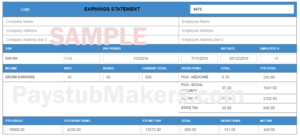
Managing Independent Contractor Payroll and Required Tax Forms
The self-employed person oversees his or her “payroll.” Thus, they are in charge of computing and putting aside taxes that would usually be the employer’s responsibility.
The main tax documents you encounter are:
- Form 1099-NEC: Clients give it to you to reveal the non-employee compensation (total income).
- Form 1040-ES: You need to work out your quarterly taxes and pay them through this form.
- Schedule C (Form 1040): You declare the gain or loss from your business when filing annual taxes.
Issuing a pay stub that accurately monitors your self-employment income and estimated tax reserve makes the quarterly tax payment process incredibly easy.
The responsibility for tax withholdings alongside Social Security is one of the most significant changes that come with the transition to a 1099 job.
The Self-Employment Tax: An employee working on W-2 will bear 50% of the FICA tax (7.65%) while the employer will also pay 50% (7.65%). In the case of a self-employed individual, it is 15.3% of net earnings for both halves.
Your 1099 income will be reflected on your pay stub in this way. By marking on the pay stub a rough tax deduction via computations, you are assuring to have enough funds to pay for this large tax obligation when your quarterly payments are due, so avoiding tax surprises.
When Are Self-Employed Workers Required to Make Pay Stubs?
Although not a legal requirement, the most sensible thing to do is to always create a pay stub every time you get paid by a client.
- Regularity Matters: After you receive a payment, make the stub right away. This will help you maintain records that are not only accurate but also that are the same, which will show a continuous pay cycle that lenders might like.
- At Least Once a Month: If your payments vary a lot, commit yourself to making a stub at least once a month so that you can better keep track of your total income and estimated taxation fund.
- Before Any Application: Always generate the latest stub before you apply for a loan, rent, or credit because companies like to have the most recent picture of your finances.
How To Create Pay Stubs That Comply with US Self-Employed Pay Stub Rules
A pay stub that is self-created must appear genuine and have all the necessary information so that it can be accepted by financial institutions.
The following are the steps to create pay stubs that comply with US Self-Employed Pay Stub Requirements:
- Use a Professional Generator: To avoid issues with format, terminology, and calculation accuracy, the use of a reliable tool such as PaystubMakers.com is recommended.
- Include All Data: It is necessary for the stub to prominently indicate the company name (or personal name/DBA), address, and EIN/SSN of the party involved.
- Reflect Estimated Taxes: Set up a tax percentage (the CPA score the best rate for you but at least 15.3% for FICA) to ensure the stub indicates that taxes will be withheld from your income.
- Print to PDF: Always make sure to download and print the final document as a high-quality PDF, which is the standard for official documentation.
Final Thoughts: The Contractor’s Financial Advantage
Being an independent contractor gives you the advantage of being flexible in finances, but you still have to deal with the records and paperworks. One of the biggest administrative issues that the 1099 pay stub can help you with is proving the regularity of your income.
Using the consistent generation of pay stubs through a reliable online tool, you convert the disorganized client payments into professionally documented evidence that supports your financial goals and helps you realize them, such as buying a house or managing your quarterly taxes with confidence. Join now and take charge of your self-employed finances!
Frequently Asked Questions (FAQs)
-
What is a “1099 Pay Stub” and why do I need one as a contractor?
A 1099 Pay Stub is a self-generated earnings statement that is used by independent contractors and self-employed individuals who receive Form 1099. Since clients do not provide traditional pay stubs, you create this document to have a standard for your financial records, monitor your estimated taxes, and provide proof of income for applications such as loans or apartment rentals, which is verifiable.
-
Is a 1099 Pay Stub a legal requirement?
To put it simply, while there is no legal obligation on the part of federal law for independent contractors to create pay stubs for themselves, the 1099 pay stub generated by the contractor can be viewed as a necessity for the purpose of establishing financial stability, as it is usually required by almost all financial institutions (banks, mortgage lenders, landlords) for a constant income statement.
-
What are the distinctions between a 1099 Pay Stub and a regular W-2 Payroll Stub?
Tax issue is the main difference. The W-2 payroll stub shows taxes that have been withheld by the employer and the 1099 pay stub presents the contractor’s estimated self-employment taxes (like FICA and federal/state income tax) which the contractor should set aside but not taxes that were actually paid out.
-
What are the important terms that relate to a 1099 Pay Stub?
You need to know that “Deductions” on the 1099 stub are tax reservations. The most notable terms include:
- Gross Pay: The total amount paid by your client(s).
- Self-Employment Tax: The whole 15.3% you need to reserve for Social Security and Medicare.
- Net Pay: The profit left after you set aside money for all the estimated taxes.
-
What is the most appropriate time for a self-employed person to hand in a pay stub?
A 1099 pay stub should be created at the moment when payment is received from a client. For lenders, it is all about the frequency of issuance, hence creating stubs on a fixed schedule (for example, bi-weekly or monthly) will provide the strongest evidence of a stable income flow.
-
How do I handle Social Security and Medicare (FICA) on my 1099 pay stub?
As a self-employed person you must pay the full 15.3% FICA tax, which includes both employee and employer contributions. The calculation of this tax, along with federal and state income taxes, should be shown as an estimated deduction on your 1099 pay stub. The tool allows you to monitor the amount of tax payments you need to send to the IRS through your quarterly estimated tax payments.
-
How do I generate a 1099 pay stub that meets US requirements?
To ensure your stub is professional and accepted:
- Use a trusted pay stub generator like PaystubMakers.com.
- Ensure the stub clearly states your name/business name, address, and SSN/EIN.
- Accurately reflect the full 15.3% self-employment tax as a deduction to show proper tax planning.
- Generate the final document as a high-quality, non-editable PDF.